
Most drivers notice something is wrong with their car long before they fully understand what is happening under the bonnet. A strange noise, a warning light on the dashboard, a slight loss of power on the motorway, these small signals are your car’s way of communicating. The challenge is knowing how to listen.
Engine diagnostics is the process that bridges this gap between symptom and solution. Rather than guessing, it uses technology to read what your vehicle’s onboard computer is actually reporting. For drivers in Bradford and across West Yorkshire, understanding this process can save time, money, and unnecessary worry.
What Is an Engine Diagnostics Check?
Modern vehicles are highly intelligent machines. Beneath the bodywork, dozens of sensors continuously monitor everything from fuel mixture and exhaust emissions to braking pressure and transmission performance. These sensors report to a central onboard computer known as an Electronic Control Unit (ECU). When a sensor detects something outside its expected range, it registers a fault code, sometimes called a Diagnostic Trouble Code (DTC) and may trigger a warning light on your dashboard.
An engine diagnostics check connects a specialist scanning tool directly to your vehicle’s OBD (On-Board Diagnostics) port. The scanner reads these stored fault codes and live data streams, giving a technician a precise, data-backed picture of what’s happening inside your engine and its connected systems rather than relying on physical inspection alone.
The Check Engine Light: What It’s Really Telling You
Few things are more unsettling for a driver than seeing the check engine light illuminate, particularly because it could mean something minor or something serious. Without engine diagnostics, there is simply no reliable way to know which.
Common triggers range widely: a loose or faulty fuel cap causing pressure loss, misfiring cylinders reducing engine efficiency, a failing oxygen sensor affecting fuel economy, a blocked Diesel Particulate Filter (DPF), catalytic converter damage, or ABS and airbag system faults.
A flashing check engine light typically signals an active, urgent fault like an engine misfire that could cause serious damage if left unaddressed. A steady light often means a stored but less immediately critical fault. Either way, engine diagnostics is the only accurate way to interpret the message.
How Fault Codes Actually Work
Fault codes follow a standardised format and are read in two tiers. Generic codes (often called OBD-II codes) apply across most vehicle makes and cover basic engine and emissions issues. Manufacturer-specific codes go deeper; they are unique to a particular brand’s systems and require brand-level diagnostic software to interpret correctly.
This distinction matters. A basic code reader from a high-street retailer might surface generic code, but without the manufacturer-level software to read deeper data, the root cause can remain hidden. This is why professional engine diagnostics equipment is significant: it reads both layers and presents live sensor data alongside stored codes, revealing patterns that a code alone cannot explain.
What Systems Can Engine Diagnostics Cover?
Modern engine diagnostics equipment goes well beyond just the engine. A thorough scan can assess multiple vehicle systems simultaneously, including:
| System | What Diagnostics Can Detect |
| Engine Management | Fuel delivery, ignition timing, misfires, sensor faults |
| Emissions & Exhaust | DPF blockages, catalytic converter issues, EGR faults |
| Transmission | Gear selection errors, clutch wear indicators, gearbox faults |
| ABS / Braking | Wheel speed sensor faults, brake pressure irregularities |
| Airbag & SRS | Deployed sensor triggers, seat belt pre-tensioner faults |
| Suspension & Steering | Electronic power steering issues, chassis fault codes |
| Comfort & Convenience | Air conditioning faults, lighting errors, heated seat malfunctions |
The ability to assess multiple systems in a single visit means that interconnected faults where one issue triggers another are far more likely to be caught early.
Why Location Matters: Mobile Engine Diagnostics in Bradford
Traditionally, getting an engine diagnostics check meant booking a garage appointment, arranging alternative transport, and waiting. For working drivers across Bradford, Leeds, Halifax, and the wider West Yorkshire region, this represents a real logistical challenge.
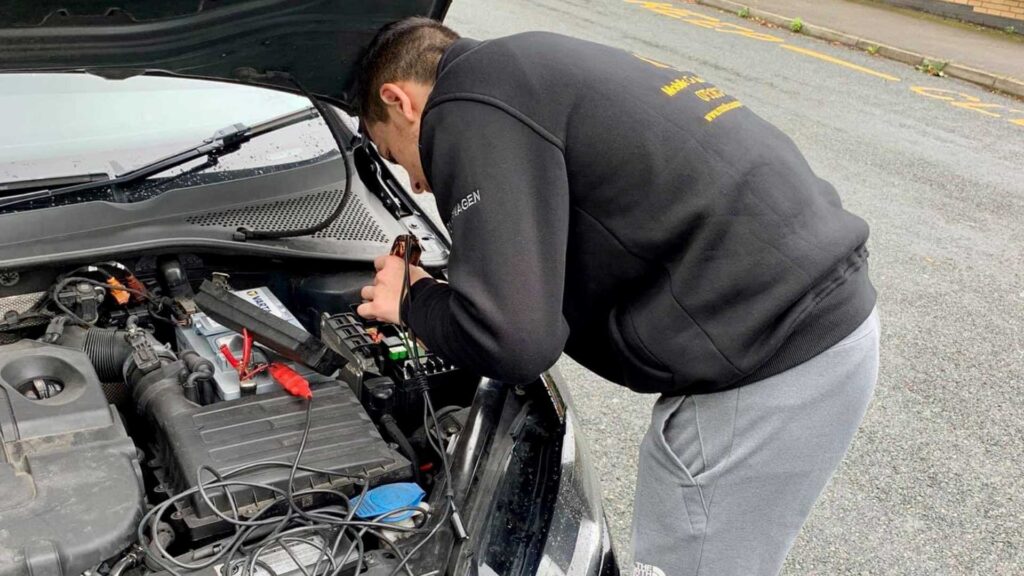
Mobile engine diagnostics changes this equation. A qualified technician comes to your location, home, workplace, or roadside with the same dealer-level equipment used in main dealerships. This approach removes the disruption and, for many faults, allows the vehicle to be diagnosed and assessed without the cost and delay of recovery or towing.
For Bradford drivers in particular, this is relevant: city traffic, limited parking near garages, and the practical inconvenience of leaving a vehicle can all make traditional servicing arrangements genuinely difficult. A mobile service sidesteps these obstacles entirely.
The Difference Between Reading a Code and Understanding a Problem
There is an important distinction worth understanding: a fault code is a starting point, not a conclusion.
Consider a common scenario: a P0300 code (random/multiple cylinder misfire detected). This code could result from worn spark plugs, a faulty ignition coil, a fuel injector problem, a vacuum leak, or even low compression in a cylinder. The code identifies that misfiring is occurring, but it does not, on its own, identify why.
This is where the expertise of the technician interpreting the data becomes as important as the equipment itself. Live data readings, watching how sensors behave in real time as the engine runs, combined with knowledge of vehicle-specific behaviours, allows a skilled auto electrician to trace the fault to its actual origin rather than simply clearing the code and hoping for the best.
Key Insight: Clearing a fault code without addressing the underlying cause is like switching off a smoke alarm. The alert disappears, but the problem remains and often worsens, leading to more extensive (and expensive) repairs down the line.
Specialist Coding: When Engine Diagnostics Goes Further
Beyond fault detection, modern engine diagnostics platforms also support vehicle coding and programming, a capability that is particularly relevant for certain brands. Volkswagen Group vehicles (VW, Audi, Seat, Skoda) use VCDS/VAGCOM and ODIS systems; Ford vehicles use FDRS-IDS; Mercedes-Benz uses the STAR system.
Coding allows technicians to activate or deactivate specific features, adapt replacement components to the vehicle’s ECU, or update software to the latest version. This is commonly required after fitting a new module, changing a battery in certain vehicles, or enabling features that were not active from the factory.
For West Yorkshire drivers who own VAG group or Mercedes vehicles, access to this level of specialist software outside of a main dealer and without main dealer pricing is a meaningful practical benefit.
DPF Issues and Why Engine Diagnostics Matter for Diesel Drivers
The Diesel Particulate Filter (DPF) is a component that captures soot from exhaust gases to reduce particulate emissions. Over time, and particularly in vehicles used primarily for short urban journeys, the filter can become blocked.
A blocked DPF will typically trigger a warning light and may cause a noticeable drop in performance. Left unaddressed, a severely blocked DPF may require costly replacement. However, if caught at an early stage, a forced regeneration process carried out with engine diagnostics equipment can restore the filter and avoid the expense.
For Bradford and Leeds drivers who make frequent short trips around the city, this is a particularly relevant risk. Understanding that your engine diagnostics scan can also monitor DPF load and soot accumulation, not just engine faults, helps explain why periodic checks offer more value than their name might suggest.
Pre-Purchase Checks: What to Know Before You Buy
Engine diagnostics is not only useful when something goes wrong. It is also a valuable tool when buying a used car privately or from a smaller dealership, where a comprehensive vehicle history may not be available.
Fault codes can be temporarily cleared before a vehicle is sold, meaning the warning lights are off, but the underlying faults remain stored in the ECU’s history. A professional engine diagnostics scan can reveal these cleared codes, providing a much more accurate picture of a vehicle’s condition before money changes hands.
Frequently Asked Questions
How long does an engine diagnostics check take?
A standard engine diagnostics scan typically takes between 30 and 60 minutes. More complex faults that require live data analysis or multiple system checks may take longer. Because a mobile technician comes to your location, there is no waiting room time or drop-off delay factored in.
Will an engine diagnostics check tell me exactly what to fix?
An engine diagnostics scan identifies fault codes and live data patterns. This gives a technician a highly informed starting point. In many cases, the fault and its cause are clear from the data. In others, further assessment may be needed to confirm the precise component to address. Either way, you will leave with a much clearer picture than you had before the scan.
Can an engine diagnostics check be done on any car?
Most vehicles manufactured after 2001 are OBD-II compliant and can be connected to a standard scanner. Dealer-level software extends this to brand-specific systems on all major makes, including Vauxhall, BMW, Mercedes, Volkswagen, Audi, Ford, and many others.
My warning light just came on. Is it safe to keep driving?
It depends on which light and how it is behaving. A steady amber warning light is usually a signal to investigate soon rather than immediately. A flashing warning light, particularly the check engine or oil pressure warning, generally means you should stop driving as soon as it is safe to do so and seek professional advice. When in doubt, it is always safer to have it checked promptly.
Understanding the Process Helps You Make Better Decisions
Engine diagnostics is not a magic solution; no single technology is. But it is, without question, the most reliable tool currently available for understanding what is actually happening inside a modern vehicle’s systems. For Bradford drivers navigating busy roads, variable weather conditions, and the realities of daily commuting, this kind of clarity is genuinely useful.
The shift toward mobile diagnostic services means that access to professional-grade equipment no longer requires a garage visit. It also means that the information you receive comes in context, explained by a technician who has seen the live data, not just handed a printout of codes.
If your vehicle is showing a warning light, behaving unusually, or if you are simply purchasing a used car and want peace of mind, a professional engine diagnostics scan is, in almost every case, a worthwhile starting point.
Contact Us
Call us: 07513 637663
Email: info@mobilecardiagnostics.co.uk