
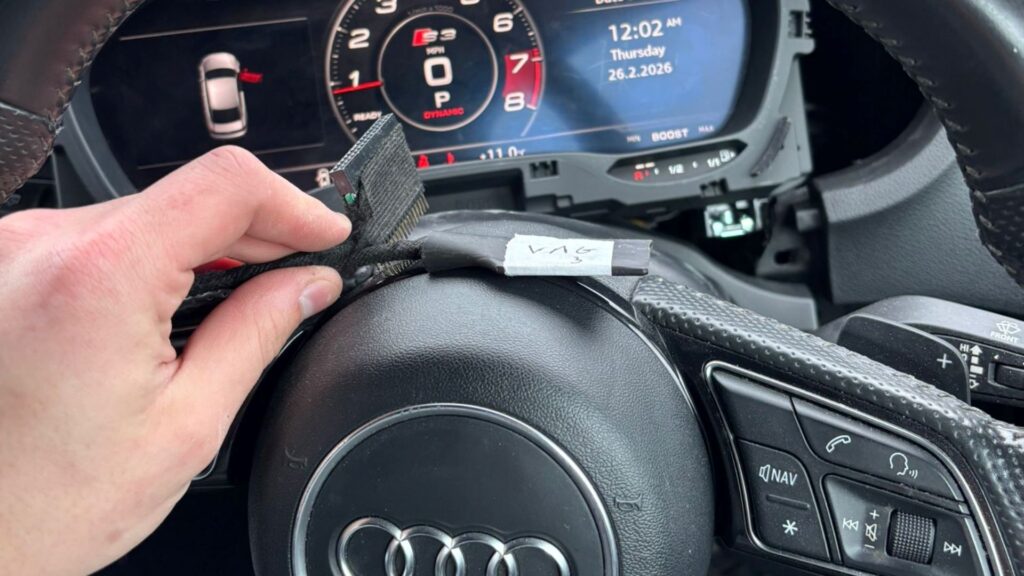
I want to be upfront with you, this blog post comes straight from a job I completed recently here in Bradford. A customer came to me needing VW ODIS coding of Audi instrument clocks, and what followed was one of those jobs that reminds you exactly why having the right tools and knowledge matters so much in this industry. I’m not writing this to sell you anything (well, not directly). I’m writing it because VW ODIS coding of Audi instrument clocks is one of those topics that’s misunderstood, mishandled, and frankly a minefield if you don’t know what you’re doing. So let me share what happened, what I learned, and what you should absolutely know before anyone touches your instrument cluster.
So, What Actually Happened on the Job?
The customer drove in (or rather, limped in) with an Audi showing a blank instrument cluster, no speed reading, no warning lights, just a black screen. The car was still driving, but the driver was essentially flying blind. After running a full diagnostic scan using ODIS (Offboard Diagnostic Information System), it became clear that the virtual instrument cluster had failed and needed to be replaced. That’s when the VW ODIS coding of Audi instrument clocks process begins — and it’s not as straightforward as most people assume.
Replacing a cluster on a VAG vehicle isn’t like swapping out a radio. The new unit has no idea what car it’s in. It doesn’t know the VIN, the mileage history, the vehicle configuration, or what optional features are installed. Without proper VW ODIS coding of Audi instrument clocks, the cluster simply won’t function — or worse, it’ll function incorrectly, showing the wrong mileage or triggering fault codes across the entire network.
What Is ODIS and Why Does It Matter for Instrument Cluster Coding?
ODIS is Volkswagen Group’s official dealer-level diagnostic software. It’s what Audi, VW, Seat, and Skoda dealerships use, and it’s the only tool that has full, licensed access to manufacturer protocols. When it comes to VW ODIS coding of Audi instrument clocks specifically, this matters enormously. Generic scan tools like Autel, Bosch, or Snap-on simply cannot complete the full coding sequence that ODIS provides. They might read fault codes and even attempt some basic adaptations, but they lack access to the security gateway, component protection system, and online server functions that make proper VW ODIS coding of Audi instrument clocks possible.
When I completed the coding on this particular Audi, ODIS connected to VW’s online infrastructure, verified the vehicle’s security credentials, and pushed the correct software variant matched to that specific car’s build data. No universal tool can replicate that process. That’s why VW ODIS coding of Audi instrument clocks should only ever be carried out with the genuine, licensed platform.
The Biggest Problem People Face: Component Protection
Component Protection is Volkswagen Group’s anti-theft system built into most electronic modules on modern VAG vehicles. It’s one of the biggest hurdles you’ll encounter during VW ODIS coding of Audi instrument clocks, and it catches a lot of people off guard. When you fit a second-hand or replacement instrument cluster, it will be locked — protected by a code tied to its previous vehicle. Without ODIS and a licensed security pass, that module will remain locked, and the car will fault constantly.
Here’s what owners typically don’t know before attempting VW ODIS coding of Audi instrument clocks:
- A second-hand cluster from a breaker’s yard will almost certainly have Component Protection active.
- Attempting removal with a non-ODIS tool can brick the module permanently — meaning you’ve just destroyed an expensive part.
- Only ODIS with a valid licensed security pass can correctly remove Component Protection through official VW Group channels.
- This applies not just to clusters, but also to body control modules, ECUs, gearbox units, and more.
What the Coding Process Actually Involves
Once Component Protection is cleared, the real VW ODIS coding of Audi instrument clocks work begins. ODIS reads the vehicle’s full configuration data — engine type, gearbox variant, installed options, market specification, and writes all of that into the new cluster. The cluster then needs a series of adaptations: things like service interval reset thresholds, warning light triggers, speed display calibration, and compatibility settings for the CAN bus network it communicates on.
What makes VW ODIS coding of Audi instrument clocks particularly involved is the sheer number of parameters that need to be matched precisely. ODIS also gives access to full workshop manuals and wiring diagrams during the process, which is invaluable when dealing with complex, multi-module cars like modern Audis. Any technician attempting VW ODIS coding of Audi instrument clocks without those resources is essentially guessing, and guessing on a CAN bus network can create cascading faults across the entire vehicle.
Common Mistakes People Make (And How to Avoid Them)
Having completed this job and spoken to several customers who’ve been burned before, here are the most common errors I see when people try to cut corners on VW ODIS coding of Audi instrument clocks:
- Using a generic tool for VAG-specific coding. Universal scanners are great for reading fault codes. They are not suitable for VW ODIS coding of Audi instrument clocks or component protection removal on VAG vehicles. Full stop.
- Buying a ‘pre-coded’ cluster online. There are sellers on various platforms claiming to supply pre-coded instrument clusters. These are rarely coded correctly for your specific vehicle. Proper VW ODIS coding of Audi instrument clocks requires your car’s VIN, options, and configuration to be matched precisely — and that can only happen with your car present and ODIS connected.
- Ignoring residual faults after fitting. Some customers drive away thinking the cluster looks fine on screen, not realising that without proper VW ODIS coding of Audi instrument clocks, other modules on the car are logging faults every time the ignition cycles. Over time, this can cause serious issues with ABS, airbag units, and stability control.
- Not checking for software updates. ODIS doesn’t just code — it also checks for available software updates through VW’s online servers. A replacement cluster may be running an older firmware version that needs updating to complete the VW ODIS coding of the Audi instrument clocks process correctly.
Why Mobile ODIS Service Makes Sense in Bradford
One thing I always emphasise to customers here in Bradford and across West Yorkshire: you don’t need to take your Audi to a main dealership to get VW ODIS coding of Audi instrument clocks carried out properly. A mobile ODIS specialist with a licensed security pass can come to you, whether you’re in Bradford, Leeds, Wakefield, Huddersfield, Halifax, Pudsey, or anywhere else across the region and carry out the same procedures the dealership would, without the main dealer price tag or the inconvenience of booking weeks in advance.
The ODIS system I use is the same licensed platform used by VW Group dealerships. It includes full workshop manuals, wiring diagrams, and access to technical bulletins (TPIs), so if there’s a known issue with a particular cluster variant during VW ODIS coding of Audi instrument clocks, I can cross-reference it instantly rather than spending hours fault-finding blind.
What You Should Ask Before Booking Any Instrument Cluster Job
If you’re looking for someone to handle VW ODIS coding of Audi instrument clocks, here are the questions worth asking any technician before you hand over your keys:
- Do you have access to ODIS with a current licensed security pass?
- Can you handle Component Protection removal through official VW Group channels?
- Will you run a full network scan after VW ODIS coding of Audi instrument clocks to confirm no residual fault codes?
- Do you carry your equipment mobile, or do I need to bring the vehicle to a fixed location?
Why Professional VW ODIS Coding Matters
VW ODIS coding of Audi instrument clocks is one of those jobs that looks simple on the surface but has several layers of complexity underneath. Get it right, and the car drives away perfectly, cluster matched, no faults, everything talking correctly on the network. Get it wrong, and you can end up with a bricked module, incorrect mileage data, or a car that generates fault codes every time it’s started.
If you’re in Bradford or anywhere across West Yorkshire and you need VW ODIS coding of Audi instrument clocks carried out on your Audi, VW, Seat, or Skoda, don’t gamble with a generic scanner or an unqualified technician. The right tool, the right access, and the right knowledge make all the difference.
And if you’d like to speak to someone who has completed this exact job and knows VW ODIS coding of Audi instrument clocks inside out, you know where to find us.
Contact Us
Call us: 07513 637663
Email: info@mobilecardiagnostics.co.uk